The Drain Cleaner Worked Yesterday, But Your Blockage Came Back Today: Why?

There is a particular kind of frustration that comes with a drain that appears fixed for less than twenty-four hours. You pour in a cleaner, wait, rinse it through, and the water starts disappearing again. By the next day, the sink is sluggish, the shower is pooling or the toilet is making the same worrying sound as before.
That short-lived improvement is useful information. It usually means the cleaner changed the obstruction without removing the reason the drain was restricted in the first place.
For people searching for a blocked drain plumber, the important shift is to stop treating every recurrence as a brand-new clog. A drain that repeatedly returns to the same problem has a history, and the history often points to something deeper than the material sitting closest to the plughole.
A cleaner can open a pathway without clearing the pipe
Many blockages are not solid plugs stretching across a pipe. They are layers, mats and irregular obstructions that leave small channels through which water can still move.
In a kitchen line, cooled grease can coat the pipe wall and catch food particles. In a bathroom line, hair can bind with soap residue into a rope-like mass. A chemical product may soften part of that material or create a narrow opening. Water then drains faster, which makes the treatment look successful.
But the pipe has not necessarily regained its original internal diameter. Fresh waste catches on the material that remains. The small opening narrows again and the symptoms return.
Timing matters. A problem that returns the next day often suggests the obstruction never truly left the system.
Tree roots behave differently from household buildup
In established Adelaide properties, particularly where older drainage runs near mature trees, roots can enter through cracks, failed joints or separations in underground pipes.
Chemical drain cleaners are not designed to repair a damaged pipe. Even if they affect organic material at the surface of a root mass, the opening in the pipe remains. Fine roots continue to seek moisture, and regrowth can begin again.
The same applies after root cutting. Removing roots can restore flow, but it does not seal the defect. If the drain repeatedly blocks in the same location, the next step is to understand the pipe condition rather than keep repeating the clearing process.
A camera inspection can show whether roots are entering at one joint, multiple points or a larger damaged section. That changes the conversation from “How do we clear this again?” to “Why does this pipe keep collecting material here?”
Damaged pipework creates its own blockage points
A drain can be thoroughly cleaned and still be likely to block again if the pipe itself is no longer smooth and correctly aligned.
A cracked clay drain may have rough edges. A displaced joint can create a lip that catches paper. A section that has dropped can hold water and solids instead of maintaining a continuous fall. In severe cases, a partly collapsed pipe can leave only a small passage open.
Each of these conditions creates a collection point. Waste that would move through a sound pipe begins settling in the damaged area, so the blockage rebuilds even when the household is using the drains normally.
This is one reason blocked drains Adelaide homeowners experience can recur despite careful habits. The cause is not always what someone is putting down the drain. Sometimes the drain itself has become the trap.
Foreign objects can move rather than disappear
Some DIY treatments shift an obstruction further along the line. A wipe, sanitary item, small plastic object or compacted mass can move from a narrow branch into a wider pipe and temporarily improve flow.
That sounds like progress, but the object may lodge at the next junction or rough section. Once there, it begins collecting paper and other waste. The symptom then returns, sometimes affecting a different fixture because the obstruction has moved downstream.
What looks like a second blockage may simply be the same material in a new position.
The speed of the return gives clues
A drain that blocks again within hours is different from one that stays clear for six months.
An immediate return can indicate that very little material was removed, that a shared line remains restricted, or that the obstruction is structural. A return after several days may suggest that a small channel was opened but the remaining deposits quickly captured more waste.
A problem that returns after heavy water use can indicate limited pipe capacity. A drain that behaves normally until the washing machine discharges or several fixtures are used together may have enough opening for light flow but not enough for peak demand.
If symptoms appear after rain, an outdoor drainage or stormwater issue may be involved rather than an ordinary internal waste blockage.
Writing down these patterns is more useful than trying several different products.
Chemical cleaners can complicate the next repair
Repeated chemical use is not only a question of effectiveness. It can create additional hazards.
Strong products may remain in standing water when the drain is still restricted. Anyone later opening a trap, using mechanical equipment or working near an overflow can be exposed to corrosive liquid. Some products can also affect seals, finishes or certain pipe materials, particularly when used repeatedly or left sitting in a blocked section.
If you have used a chemical cleaner and then call a plumber, tell them exactly what was used and when. That information helps them choose a safer approach.
A proper diagnosis separates cleaning from repair
A blocked drain plumber will usually begin by working out whether the issue is local to one fixture, limited to a branch or deeper in the main property drain. The pattern of affected fixtures, previous blockages and property age all help.
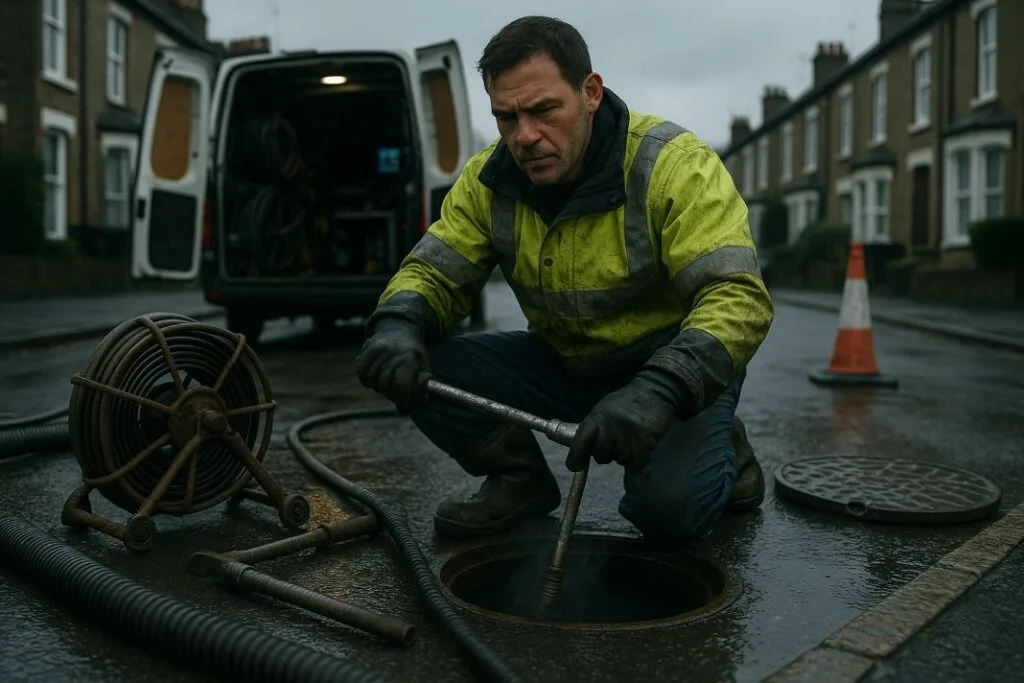
The line can then be cleared using equipment suited to the obstruction and pipe condition. High-pressure water jetting is often used for grease, sludge and some root material where appropriate. Mechanical tools may suit other obstructions.
If the blockage has returned repeatedly, CCTV inspection becomes especially valuable after clearing. The camera can confirm whether the line is clean and reveal cracks, roots, displaced joints, foreign objects or standing water caused by poor fall.
Stop counting temporary wins as permanent fixes
A drain cleaner that buys one quiet day has told you something important: flow can be restored, but the system is not staying clear.
For a one-off, shallow blockage, simple household cleaning may be enough. For a problem that keeps returning, repeating the same treatment usually creates the same result. The better question is what remains inside the pipe, or what condition of the pipe is causing waste to collect there.
When recurring blocked drains Adelaide households deal with are investigated at that level, the solution can be matched to the cause rather than the latest symptom. That is what turns a frustrating cycle of clearing and reblocking into a repair plan that actually makes sense.